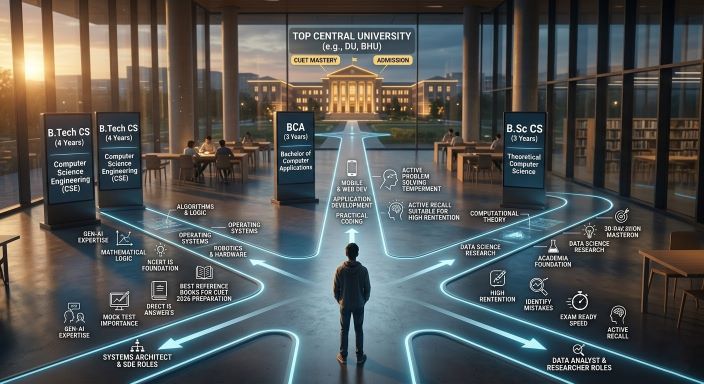
Which Degree is Better for a Career in Software?
The Great Tech Debate: BCA, B.Tech, or B.Sc?
If you want to enter the IT industry, the most common question is: Which degree is better for a career in software? In 2026, the answer has shifted. While a degree used to be the only gatekeeper, today’s recruiters in Bangalore and Pune are looking for a mix of foundational theory and “hands-on” AI-driven coding skills.
Choosing the right path depends on your 12th-grade background and your long-term goals. Whether you are coming from a PCB or PCM background, the software world has space for everyone. To ensure your degree is recognized by top recruiters, you should always check the AICTE official portal for a list of approved institutions and updated technical curriculum standards.
1. B.Tech Computer Science (The “Architect” Path)
B.Tech remains the “Gold Standard” for high-end engineering roles. It is a 4-year professional degree that dives deep into how computers work at a fundamental level.
-
Best for: Students who love Mathematics and want to build complex systems like AI models, Operating Systems, or Cloud Infrastructure.
-
The Advantage: Most “Product-Based Companies” (Google, Microsoft, Amazon) still prefer B.Tech graduates for their core engineering teams.
-
Average Starting Salary (2026): ₹4.5 – ₹12 LPA.
2. BCA – Bachelor of Computer Applications (The “Builder” Path)
BCA is a 3-year degree focused almost entirely on the practical application of software. If you want to start coding and building apps quickly, this is your route.
-
Best for: Students who want a faster entry into the job market or those from non-PCM backgrounds (Commerce/Arts) who have a passion for coding.
-
The Advantage: It is more budget-friendly and less focused on “Physics/Chemistry” than B.Tech. To match a B.Tech’s salary, most BCA students pursue an MCA later.
-
Average Starting Salary (2026): ₹3 – ₹8 LPA.
3. B.Sc Computer Science (The “Researcher” Path)
B.Sc CS is a 3-year academic degree that focuses on computational theory and logic.
-
Best for: Students interested in academia, data science, or research-oriented roles.
-
The Advantage: It provides a strong logical foundation, which is essential if you plan to go for a Master’s or PhD in specialized fields like Robotics or Advanced AI.
-
Average Starting Salary (2026): ₹2.5 – ₹6 LPA.
Salary and Role Comparison (2026 Estimates)
| Degree | Duration | Focus Area | Top Job Roles |
| B.Tech CS | 4 Years | Engineering & Logic | SDE, Cloud Architect, AI Engineer |
| BCA | 3 Years | App Development | Web/App Developer, Software Tester |
| B.Sc CS | 3 Years | Theoretical Foundation | Data Analyst, Systems Admin, Researcher |
The “Skill-Over-Degree” Trend
In 2026, the question “Which degree is better for a career in software?” is often answered by your portfolio. A BCA student with a top online certification in AI and a strong GitHub profile can often land a higher package than a B.Tech student who only has theoretical knowledge.
To stay competitive, you must avoid the passive reading trap. Regardless of your degree, you need to solve real-world problems and contribute to open-source projects.
Conclusion: Which One Should You Choose?
-
Choose B.Tech if you have a PCM background and want the “Engineer” tag with a deep technical foundation.
-
Choose BCA if you want to start your career early and focus on practical coding without heavy science subjects.
-
Choose B.Sc CS if you are interested in the “Science” of computing and plan for higher research.
For those aiming for top-tier government colleges via entrance exams, make sure you are following a solid revision strategy for your entrance tests.

You may also like

New 9-Point Grading System: Decode Your 2026 Report Card

Internal Assessments vs. Theory: The 2026 Marking Split