
NCERT Solutions – Probability Exercise 15.1
Exercise 15.1
Q.1 In a cricket match, batswoman hits a boundary 6 times out of 30 balls she plays. Find the probability that she did not hit a boundary.
Sol.
Since in a cricket match ,a batswoman hits a boundary 6 times out of 30 balls she plays i.e., she missed the boundary 30 – 6 = 24 times out of 30 balls.
Therefore, the probability that a batswoman does not hit a boundary.
=NumberofnothittingaboundaryTotalnumberoftrials(i.e.,balls)
=2430=45
Q.2 1500 families with 2 children were selected randomly, and the following data were recorded :

Compute the probability of a family, chosen at random having
(i) 2 girls (ii) 1 girl (iii) No girl
Also check whether the sum of these probabilities is 1.
Sol.
Let E0,E1andE2 be the event of getting no girl, 1girl and 2 girls.
(i) Therefore P(E2) = Probability of a family having 2 girls
=Numberoffamilieshaving2girlsTotalnumberofgirls
=4751500=1960
(ii) Therefore P(E1) = Probability of a family having 1 girl
=Numberoffamilieshaving1girlsTotalnumberoffamilies
=8141500=407750
(iii) Therefore P(E0) = Probability of a family having no girls
=NumberoffamilieshavingnogirlsTotalnumberoffamilies
=2111500
Therefore Sum of probabilities = P(E0)+P(E1)+P(E2)
=2111500+407750+1960
=211+814+4751500=15001500=1
Q.3 Refer to Example 5, section 14.4 Chapter 14. Find the probability that a student of the class was born in August.
Sol.
Clearly from the histograph six students were born in the month of August out of 40 students of a particular section of class – IX.
Probability that a student of the class was born in August
=NumberofstudentsborninAugustTotalnumberofstudents
=640=320
Q.4 Three coins are tossed simultaneously 200 times with the following frequencies of different outcomes :

If the three coins are simultaneously tossed again, compute the probability of 2 heads coming up.
Sol.
Since three coins are tossed 200 times, so the total number of trials is 200.
Probability of getting 2 heads
=No.ofoutcomeshaving2headsTotalno.oftrials
=72200
=925
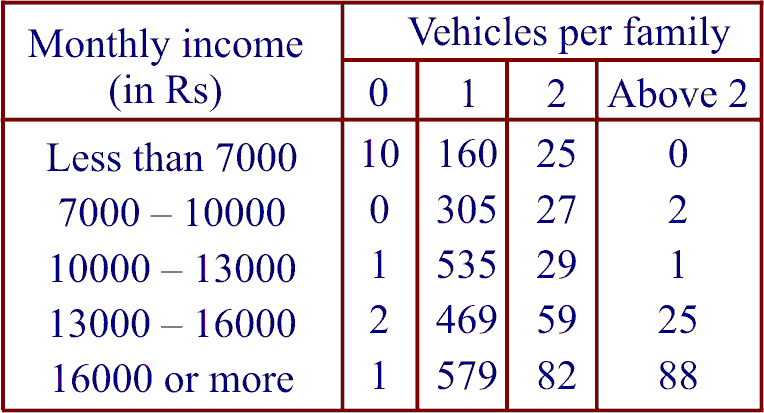
Q.5 An organisation selected 2400 families at random and surveyed them to determine a relationship between income level and the number of vehicles in a family.
The information gathered is listed in the table below :
Suppose a family is chosen. Find the probability that the family chosen is
(i) earning Rs 10000-13000 per month and owning exactly 2 vehicles.
(ii) earning Rs 16000 or more per month and owning exactly 1 vehicles.
(iii) earning less than Rs 7000 per month and does not own any vehicle.
(iv) earning Rs 13000 -16000 per month and owning more than 2 vehicles.
(v) owning not more than 1 vehicle
Sol.
The total number of families = 2400
(i) Number of families earning Rs 10000 – 13000 per month and owning exactly 2 vehicles = 29.
Therefore, P (families earning Rs 10000 – 13000 per month and owning exactly 2 vehicles)
=292400
(ii) Number of families earning Rs 16000 or more per month and owning exactly 1 vehicle = 579.
Therefore P (Families earning Rs 16000 or more per month and owning exactly 1 vehicle)
=5792400
=193800
(iii) Number of families earning less than Rs. 7000 per month and does not own any vehicle = 10
Therefore, P (Families earning less than Rs 7000 per month and does not own any vehicle)
=102400=1240
(iv) Number of families earning Rs 13000 – 16000 per month and owning more than 2 vehicles = 25
Therefore, P (Families earning Rs 13000 – 16000 per month and owning more than two vehicles)
=252400=196
(v) Number of families owning not more than 1 vehicle
= Families having no vehicle + Families having 1 vehicle
= (10 + 0 + 1 + 2 + 1) + (160 + 305 + 535 + 469 + 579)
= 14 + 2048 = 2062
P (Families owning not more than 1 vehicle)
=20622400=10311200
Q.6 Refer to Table 14.7 Chapter 14.
(i) Find the probability that a student obtained less than 20% in the mathematics test.
(ii) Find the probability that a student obtained marks 60 or above.
Sol.
Total number of students in mathematics is 90.
(i) Clearly, from the given table, the number of student who obtained less than 20% marks in the mathematics test = 7.
P (a student obtaining less than 20% marks) = 790
(ii) Clearly, from the given table, number of students who obtained marks 60 or above.
= (students in 60 – 70) + (students above 70)
= 15 + 8 = 23
Therefore, P (a student obtaining marks 60 and above) = 2390
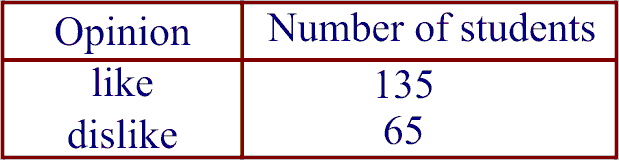
Q.7 To know the opinion of the students about the subject statistics, a survey of 200 students was conducted. The data is recorded in the following table.
Find the probability that a student chosen at random
(i) likes statistics, (ii) does not like it.
Sol.
The total number of students = 200
(i) P (a student likes statistics)
=NumberofstudentswholikestatisticsTotalnumberofstudents
=135200=2740
(ii) P (a student does not like statistics)
=NumberofstudentswhodoesnotlikestatisticsTotalnumberofstudents
=65200=1340
Q.8 Refer to Q.2, Ex 14.2. What is the empirical probability that an engineer lives :
(i) less than 7 km from her place of work?
(ii) more than or equal to 7 km from her place of work?
(iii) within 12km from her place of work?
Sol.
Total number of engineers = 40
(i) Number of engineers living less than 7 km from their place of work = 9
Therefore P (an engineer lives less than 7 km from her place of work)
=940
(ii) Number of engineers living more than or equal to 7km from her place of work = 31
Therefore P (an engineer lives less than or equal to 7 km from her place of work)
=3140
(iii) Number of engineer lives within 12 km from her place of work = 0
Therefore P (an engineer lives with 12 km from her place of work) = 040=0
Q.9 Activity : Note the frequency of two- wheeler, three – wheeler and four – wheeler going past during a time interval, in front of your school gate.
Find the probability that any one vehicle out of the total vehicles you have observed is a two wheeler.
Sol. Activity problem : Collect the data and find the desired probability.
Q.10 Activity : Ask all the students in your class to write a 3-digit number. Choose any student from the room at random. What is the probability that the number written by her/him is divisible by 3? Remember that a number is divisible by 3, if the sum of its digits is divisible by 3.
Sol. Activity problem : Do as directed and find the desired probability.
Q.11 Eleven bags of wheat flour, each marked 5 kg , actually contained the following weights of flour (in kg) :
4.97 5.05 5.08 5.03 5.00 5.06 5.08 4.98 5.04 5.07 5.00
Find the probability that any of these bags chosen at random contains more than 5kg of flour.
Sol.
Total number of wheat bags = 11
Number of bags having more than 5 kg = 7
Therefore P(a bag contains more than 5kg ) = 711
Q.12 In Q.5 Exercise 14.2 you were asked to prepare a frequency distribution table, regarding the concentration of sulphur dioxide in the air in parts per million of a certain city for 30 days. Using this table, find the probability of the concentration of sulphur dioxide in the interval 0.12 – 0.16 on any of these days.
Sol.
Total number of days = 30
Concentration of sulphur dioxide in 0.12 – 0.16 on any day = 2
Therefore , required probability =230=115
Q.13 In Q. 1, Exercise 14.2, you were asked to prepare a frequency distribution table regarding the blood group of 30 students of a class. Use this table to determine the probability that a student of this class, selected at random, has blood group AB.
Sol.
Total number of students = 30
Number of students having blood group AB = 3
Therefore Required probability =330=110