Chapter Notes – Linear Equations
(1) An equation of the form ax+by+c=0, where a, b, c are real numbers such that a and b not both zero is called a linear equation in two variables.
For Example: 2x+3y+5=0, where a=2, b=3 which are not zero. So this is linear equation in two variables.
(2) A linear equation in two variables has infinitely many solutions.
For Example: we have 4x−y−3=0, there is many solution
If we take x=1 , y=1 then LHS=4×1−1−3=0=RHS
If we take x=2 , y=5 then LHS=4×2−5−3=0=RHS
(3) The graph of a linear equation in two variables is a straight line.
For Example:
x+y=4
We have x+y=4⇒y=4−x
When x=0, we have: y=4−0=4
When x=2, we have: y=4−2=2
When x=4, we have: y=4−4=0
Thus, we have the following table: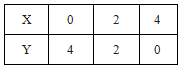 Plotting the points (0, 4) (2, 2) and (4, 0) on the graph paper and drawing a line joining them.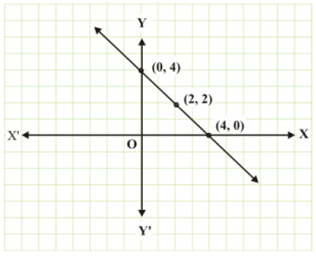
(4) The equations of x and y-axes are y=0 and x=0 respectively.
For Example:
x+3=0 equation is for x-axes because in this equation y=0.
7y−3=0 equation is for y-axes because in this equation x=0.
(5) The graph of the equation x=a is a straight line parallel to y-axis.
For Example:
The equation for such a line x=−92 is given below: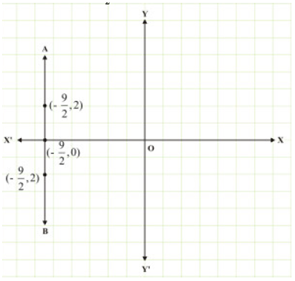
(6) The graph of the equation y=a is a straight line parallel to x-axis.
For Example: For a line that is parallel to the x-axis, the equation for such a line y=2 is given below: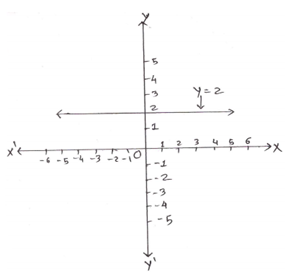
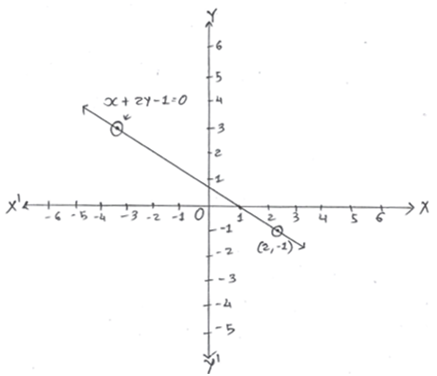
(7) Every point on the graph of a linear equation in two variables is a solution of the equation. Conversely, every solution of linear equation in two variables represents a point on the graph of the equation.
For Example: In linear equation f(x)=x+2y−1=0 , (3,−1) also lies on this line.