
Chapter Notes – Constructions
Some Important Points
1) To Draw the Bisector of a line segment.
Example: Draw a line segment 5.8 cm long and draw its perpendicular bisector.
Construction: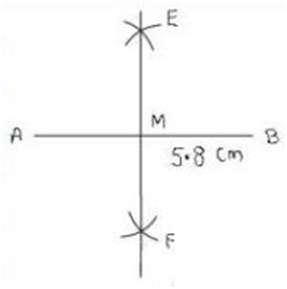 1: Draw a line segment AB=5.8 cm by using graduated ruler.
2: With a centre and radius more than half of AB, draw arcs, one on each side of AB.
3: With B centre and some radius as in step 2, draw arcs cutting the arcs drawn in step-2 at E and F respectively.
4: Draw the line segment with E and F as end Points.
The Line segment EF is the required perpendicular bisector of AB.
2) To draw the bisector of a given angle.
Example: Construct an angle of 45∘ at the initial point of a given ray and justify the Construction.
Construction: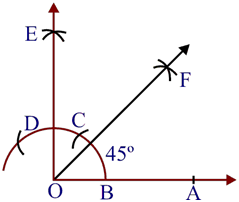 1: Draw a ray OA.
2: With O as centre and any suitable radius draw an arc cutting OA at B.
3: With B as centre and same radius cut the previous drawn arc at C and then with C as centre and same radius cut the arc at D.
4: With C as centre and radius more than half CD draw an arc.
5: With D as Centre and same radius draw another arc to cut the previous arc at E.
6: Join OE. Then ∠AOE=90∘
7: Draw the bisector OF of ∠AOE then ∠AOF=45∘
By Construction ∠AOE=90∘ and OF is the bisector of ∠AOE
Therefore, ∠AOF=12∠AOE=12×90∘=45∘
3) Construct an equilateral triangle, given its side and justify the construction.
Example: Draw an equilateral triangle of side 4.6 cm
Construction: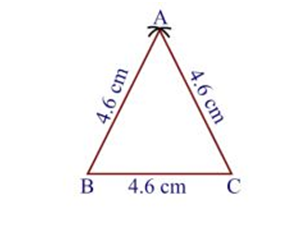 1: Draw BC = 4.6 cm
2: With B and C as centres and Radii equal to BC=4.6 cm, draw two arcs on the same side of BC, intersecting each other at A.
3: Join AB and AC.
Justification : Since by construction :
AB = BC = CA = 4.6 cm
Therefore ΔABC is an equilateral triangle.
4) Construction of a triangle when its Base, Sum of the other two sides and one base angle are given.
Example: Construct a triangle ABC in which BC = 7 cm, ∠B=75∘ and AB + AC = 13 cm.
Construction: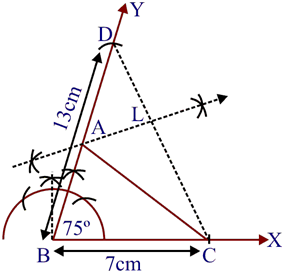 1: Draw a ray BX and cut off a line segment BC = 7 cm
2: Construct ∠XBY=75∘
3: From BY, cut off BD = 13 cm.
4: Join CD.
5: Draw the perpendicular bisect of CD, intersecting BA at A.
6: Join AC.
The triangle ABC thus obtained is the required triangle.
5) Construction of a triangle when its base, difference of the other two sides and one base angle are given.
Example: Construct a triangle PQR in which QR = 6 cm ∠Q=60∘ and PR – PQ = 2 cm.
Construction: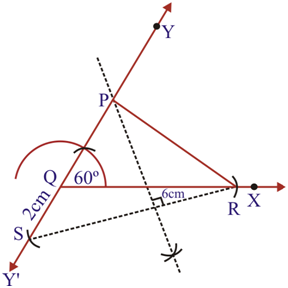 1: Draw a QX and Cut off a line segment QR= 6 cm from it.
2: Construct a ray QY making an angle of 60∘ with QR and Produce YQ to form a line YQY’
3: Cut off a line segment QS = 2cm from QY’.
4: Join RS.
5: Draw perpendicular bisector of RS intersecting QY at a ponit P.
6: Join PR.
Then PQR is the required triangle.