
Chapter Notes – Area of Parallelogram
(1) Prove that a diagonal of a parallelogram divides it into two triangles of equal area.
Given: A parallelogram ABCD in which BD is one of the diagonals.
To prove:
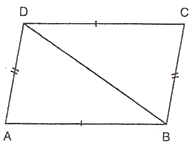 Proof: Since two congruent geometrical figures have equal area. Therefore, in order to prove that
 it is sufficient to show that
ΔABD≅ΔCDB
In Δs ABD and CDB, we have
AB=CD
AD=CB
And, BD=DB
So, by SSS criterion of congruence, we have
ΔABD≅ΔCDB
Hence, ar(ΔABD)=ar(ΔCDB)
(2) Prove that parallelograms on the same base and between the same parallels are equal in area.
Given: Two parallelograms ABCD and ABEF, which have the same base AB and which are between the same parallel lines AB and FC.
To prove: ar(parallelogramABCD)=ar(parallelogramABCD)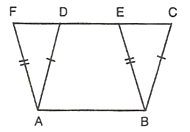 Proof: In Δs ADF and BCE, we have
AD=BC
AF=BE
And, ∠DAF=∠CBE [ ⸪ AD∥BC and AF∥BE]
So, by SAS criterion of congruence, we have
ΔADF≅ΔBCE
ar(ΔADF)=ar(ΔBCE) …..(i)
Now, ar(parallelogram ABCD)=ar(sq.ABED)+ar(ΔBCE)
ar(parallelogram ABCD)=ar(sq.ABED)+ar(ΔADF) [Using(i)]
ar(parallelogram ABCD)=ar(parallelogram ABEF)
Hence, ar(parallelogram ABCD)=ar(parallelogram ABEF)
(3) Prove that the area of a parallelogram is the product of its base and the corresponding altitude.
Given: A parallelogram ABCD in which AB is the base and AL the corresponding altitude.
To prove: ar(parallelogram ABCD)=AB×AL
Construction: Complete the rectangle ALMB by drawing BM⊥CD.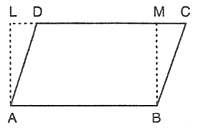 Proof: Since ar(parallelogram ABCD) and rectangle ALMB are on the same base and between the same parallels.
ar(parallelogram ABCD)
=ar(rect.ALMB)
=AB×AL [By rect. Area axiom area of a rectangle = Base X Height]
Hence, ar(parallelogram ABCD)=AB×AL
(4) Prove that parallelograms on equal bases and between the same parallels are equal in area.
Given: Two parallelograms ABCD and PQRS with equal bases AB and PQ and between the same parallels AQ and DR.
To prove: ar(parallelogram ABCD)=ar(parallelogram PQRS)
Construction: Draw AL⊥DR and PM⊥DR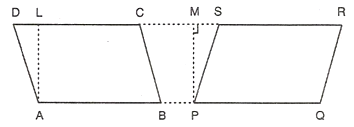 Proof: Since AB⊥DR, AL⊥DR and PM⊥DR
AL=PM
Now, ar(parallelogram ABCD)=AB×AL
ar(parallelogram ABCD)=PQ×PM [AB=PQ and AL=PM]
ar(parallelogram ABCD)=ar(parallelogram PQRS)
(5) Prove that triangles on the same bases and between the same parallels are equal in area.
Proof: We have,
BD∥CA
And, BC∥DA
sq.BCAD is a parallelogram.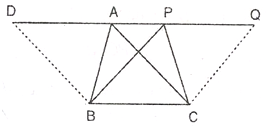 Similarly, sq.BCQP is a parallelogram.
Now, parallelograms ECQP and BCAD are on the same base BC, and between the same parallels.
ar(parallelogram BCQP)=ar(parallelogram BCAD) ….(i)
We know that the diagonals of a parallelogram divides it into two triangles of equal area.
ar(ΔPBC)=12ar(parallelogram BCQP) …..(ii)
And, ar(ΔABC)=12ar(parallelogram BCAQ) ….(iii)
Now, ar(parallelogram BCQP)=ar(parallelogram BCAD) [ From (i)]
12ar(parallelogram BCQP)=12ar(parallelogram BCAD)
ar(ΔABC)=ar(ΔPBC) [From (ii) and (iii)]
Hence, ar(ΔABC)=ar(ΔPBC)
(6) Prove that the area of a triangle is half the product of any of its sides and the corresponding altitude.
Given: A ΔABC in which AL is the altitude to the side BC.
To prove: ar(ΔABC)=12(BC×AL)
Construction: Through C and A draw CD∥BA and AD∥BC respectively, intersecting each other at D.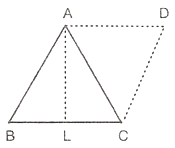 Proof: We have,
BA∥CD
And, AD∥BC
BCDA is a parallelogram.
Since AC is a diagonal of parallelogram BCDA.
ar(ΔABC)=12ar(parallelogram BCAD)
ar(ΔABC)=12(BC×AL) [BC is the base and AL is the corresponding altitude of parallelogram BCDA]
(7) Prove that if a triangle and a parallelogram are on the same base and between the same parallels, then the area of the triangle is equal to the half of the parallelogram.
Given: A ΔABC and a parallelogram BCDE on the same base BC and between the same parallel BC and AD.
To prove: ar(ΔABC)=12ar(parallelogram BCDE)
Construction: Draw AL⊥BC and DM⊥BC, meeting BC produced in M.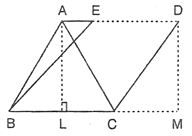 Proof: Since A, E and D are collinear and BC∥AD
AL=DM …..(i)
Now,
ar(ΔABC)=12(BC×AL)
ar(ΔABC)=12(BC×DM) [AL=DM (from (i)]
ar(ΔABC)=12ar(parallelogram BCDE)
(8) Prove that the area of a trapezium is half the product of its height and the sum of parallel sides.
Given: A trapezium ABCD in which AB∥DC; AB=a, DC=b and AL=CM=h, where AL⊥DC and CM⊥AB.
To prove: ar(trap. ABCD)=12h×(a+b)
Construction: Join AC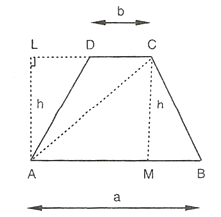 Proof: We have,
ar(trap. ABCD)=ar(ΔABC)+ar(ΔACD)
ar(trap. ABCD)=12(AB×CM)+12(DC×AL)
ar(trap. ABCD)=12ah×12bh [AB=a and DC=b]
ar(trap. ABCD)=12h×(a+b)
(9) Prove that triangles having equal areas and having one side of one of the triangles, equal to one side of the other, have their corresponding altitudes equal.
Given: Two triangles ABC and PQR such that:
ar(ΔABC)=ar(ΔPQR)
AB=PQ
CN and RT are the altitudes corresponding to AB and PQ respectively of the two triangles.
To prove: CN=RT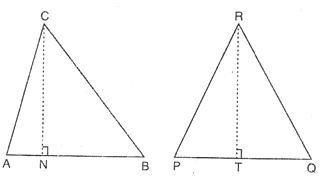 Proof: In ΔABC, CN is the altitude corresponding to side AB.
ar(ΔABC)=12(AB×CN) ….(i)
Similarly, we have,
ar(ΔPQR)=12(PQ×RT) …..(ii)
Now, ar(ΔABC)=ar(ΔPQR)
12(AB×CN)=12(PQ×RT)
(AB×CN)=(PQ×RT)
(PQ×CN)=(PQ×RT) [ AB=PQ (Given)]
CN=RT
(10) Prove that if each diagonal of a quadrilateral separates it into two triangles of equal area, then the quadrilateral is a parallelogram.
Given: A quadrilateral ABCD such that its diagonals AC and BD are such that
ar(ΔABD)=ar(ΔCDB) and ar(ΔABC)=ar(ΔACD)
To prove: Quadrilateral ABCD is a parallelogram.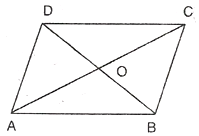 Proof: Since diagonal AC of the quadrilateral ABCD separates it into two triangles of equal area. Therefore,
ar(ΔABC)=ar(ΔACD) …..(i)
But, ar(ΔABC)+ar(ΔACD)=ar(quad.ABCD)
2ar(ΔABC)=ar(quad.ABCD) [Using (i)]
ar(ΔABC)=12ar(quad.ABCD) ….(ii)
Since diagonal BD of the quadrilateral ABCD separates it into triangles of equal area.
ar(ΔABD)=ar(ΔBCD) ….(iii)
But, ar(ΔABD)+ar(ΔBCD)=ar(quad.ABCD)
2ar(ΔABD)=ar(quad.ABCD) [Using(iii)]
ar(ΔABD)=12ar(quad.ABCD) …..(iv)
From (ii) and (iv), we get
ar(ΔABC)=ar(ΔABD)
Since Δs ABC and ABD are on the same base AB. Therefore they must have equal corresponding altitudes.
i.e. Altitude from C of ΔABC = Altitude from D of ΔABD
DC∥AB
Similarly, AD∥BC
Hence, quadrilateral ABCD is a parallelogram.
(11) Prove that the area of a rhombus is half the product of the lengths of its diagonals.
Given: A rhombus ABCD whose diagonals AC and BD intersect at O.
To prove: ar(rhombus ABCD) =12(AC×BD)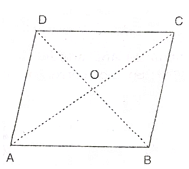 Proof: Since the diagonals of a rhombus intersect at right angles. Therefore,
OB⊥AC and OD⊥AC
ar(rhombus) =ar(ΔABC)+ar(ΔADC)
ar(rhombus) =12(AC×BO)+12(AC×DO)
ar(rhombus)=12(AC×(BO+DO))
ar(rhombus) =12(AC×BD)
(12) Prove that diagonals of a parallelogram divide it into four triangles of equal area.
Given: A parallelogram ABCD. The diagonals AC and BD intersect at O.
To prove: ar(ΔOAB)=ar(ΔOBC)=ar(ΔOCD)=ar(ΔAOD)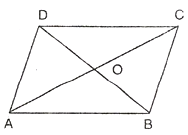 Proof: Since the diagonals of a parallelogram bisect each other at the point of intersection.
OA=OC and OB=OD
Also, the median of a triangle divides it into two equal parts.
Now, in ΔABC, BO is the median.
ar(ΔOAB)=ar(ΔOBC) ….(i)
In ΔBCD, CO is the median
ar(ΔOBC)=ar(ΔOCD) …..(ii)
In ΔACD, DO is the median
ar(ΔOCD)=ar(ΔAOD) ….(iii)
From (i), (ii) and (iii), we get
ar(ΔOAB)=ar(ΔOBC)=ar(ΔOCD)=ar(ΔAOD)
(13) Prove that if the diagonals AC and BD of a quadrilateral ABCD, intersect at O and separate the quadrilateral into four triangles of equal area, then the quadrilateral ABCD is parallelogram.
Given: A quadrilateral ABCD such that its diagonals AC and BD intersect at O and separate it into four parts such that
ar(ΔOAB)=ar(ΔOBC)=ar(ΔOCD)=ar(ΔAOD)
To prove: Quadrilateral ABCD is a parallelogram.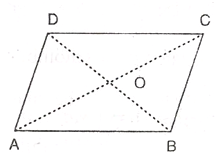 Proof: We have,
ar(ΔAOD)=ar(ΔBOC)
ar(ΔAOD)+ar(ΔAOB)=ar(ΔBOC)+ar(ΔAOB)
ar(ΔABD)=ar(ΔABC)
Thus, Δs ABD and ABC have the same base AB and have equal areas. So, their corresponding altitudes must be equal.
Altitude from ΔABD Altitude from C of ΔABC
DC∥AB
Similarly, we have, AD∥BC.
Hence, quadrilateral ABCD is a parallelogram.
(14) Prove that a median of a triangle divides it into two triangles of equal area.
Given: A ΔABC in which AD is the median.
To prove: ar(ΔABD)=ar(ΔADC)
Construction: Draw AL⊥BC.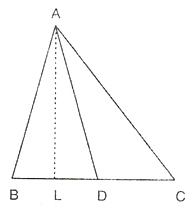 Proof: Since AD is the median of ΔABC. Therefore, D is the mid point of BC.
BD=DC
BD×AL=DC×AL [ Multiplying both sides by AL]
12(BD×AL)=12(DC×AL)
ar(ΔABD)=ar(ΔADC)
ALITER Since Δs ABD and ADC have equal bases and the same altitude AL.
ar(ΔABD)=ar(ΔADC)