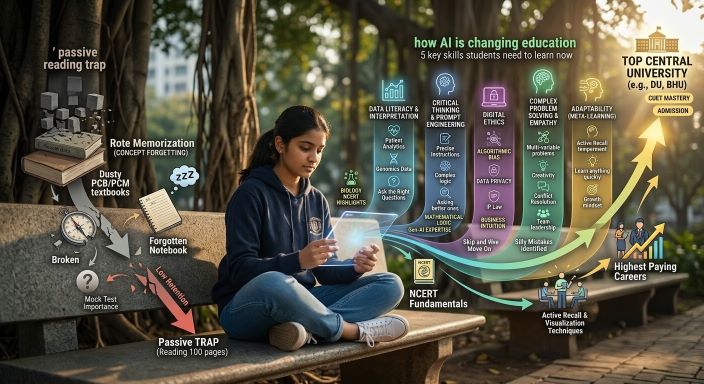
How AI is Changing Education: Top 5 Skills for Students
The Classroom of the Future is Here
From personalized tutoring algorithms to automated grading systems, there is no denying that how AI is changing education is one of the most significant shifts of our time. This isn’t just about using ChatGPT to summarize a chapter; it’s a fundamental change in the “Learning-to-Earning” pipeline. In 2026, the value of a student is no longer measured by how much information they can memorize, but by how effectively they can collaborate with intelligent machines.
If you are currently choosing your streams, remember that how AI is changing education means blurring the lines between traditional subjects. Engineering now requires biology for healthcare tech, and doctors require data science for genomics. While your CUET UG 2026 Syllabus will test your domain knowledge, thriving long-term requires mastering skills that machines cannot easily replicate.
1. Data Literacy and Interpretation
AI generates massive amounts of data, but it needs humans to give that data meaning. This is a core part of how AI is changing education: we are moving from “finding answers” to “interpreting results.” Every professional—from a Specialized Doctor reviewing patient analytics to a financial analyst—must know how to spot biases and interpret data accurately.
2. Critical Thinking & Prompt Engineering
Knowing what to ask is the most important skill of the decade. This is a direct result of how AI is changing education, shifting the focus from answering questions to asking better ones. Prompt engineering is the art of providing precise instructions to an AI to get the best possible output. This requires a deep understanding of logic and language, going far beyond the basic vocabulary found in the best reference books for CUET 2026 preparation.
3. Digital Ethics and Governance
With great power comes great responsibility. As we witness how AI is changing education, students must understand the ethical implications of the tools they use. This includes understanding algorithmic bias, data privacy laws, and intellectual property. Whether you become a Corporate Lawyer or a software developer, your ability to navigate the “gray areas” of tech ethics will be a highly paid skill.
4. Complex Problem Solving and Empathy
While AI handles structured, repetitive tasks with ease, humans are still needed for “messy,” multi-variable problems. This includes negotiation, conflict resolution, and understanding human psychology. How AI is changing education is actually making “Soft Skills” the new “Hard Skills.” A machine can write code, but it cannot yet lead a diverse team through a crisis.
5. Adaptability (Meta-Learning)
The only constant in 2026 is change. The most valuable skill is no longer “knowing one thing,” but “knowing how to learn anything quickly.” This requires the type of active recall and “growth mindset” we discussed in our guide on mock test importance. If you can unlearn old methods and adopt new AI-driven workflows every six months, you will be unstoppable.
Balancing High-Tech Skills with High-Touch Education
As we analyze how AI is changing education, it’s clear that you shouldn’t neglect your core foundation. The path to the Top 10 Central Universities in India still requires excelling in your domain subjects. Physics, Chemistry, and Math remain the pillars of innovation; AI just changes how we apply them.
However, you must move away from the passive reading trap. AI can summarize a 500-page book in seconds, so your value lies in how you apply that knowledge to real-world scenarios. The future of how AI is changing education favors those who use technology as a super-powered assistant rather than a replacement for their own brain.
Conclusion: The Future Favors the Curious
Understanding how AI is changing education means recognizing that the future belongs to the adaptable. Don’t fear the machine—learn to lead it. For official updates on tech-integrated exams and modern counseling, always visit the NTA official portal.

You may also like

New 9-Point Grading System: Decode Your 2026 Report Card

Internal Assessments vs. Theory: The 2026 Marking Split